
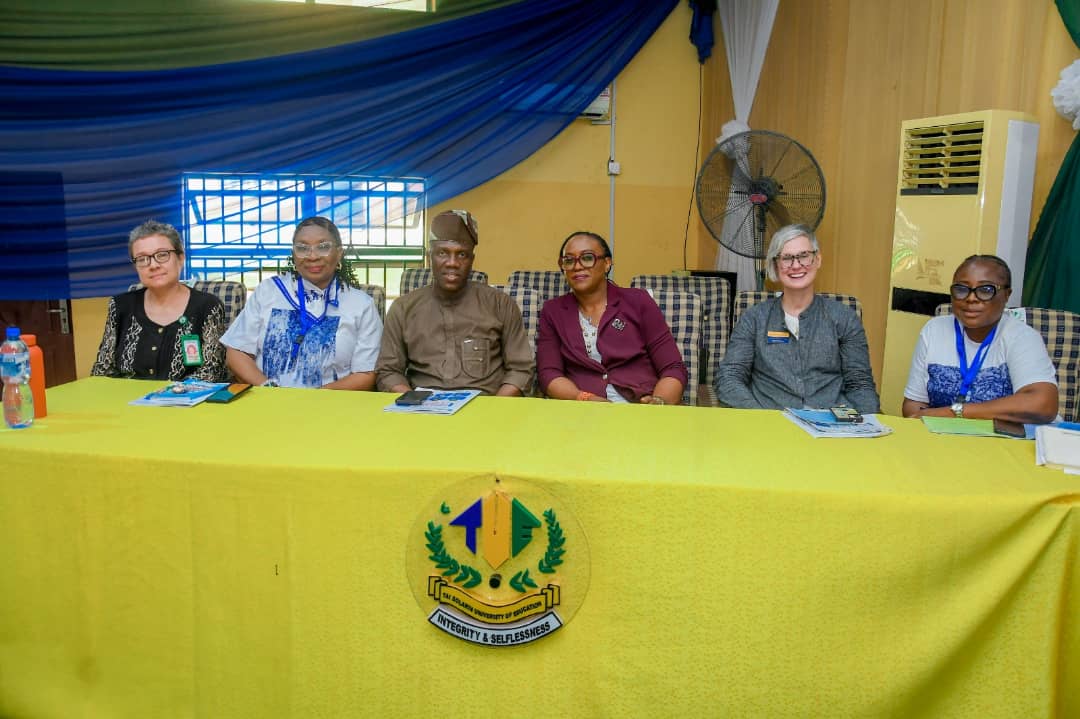
The Vice-Chancellor, Tai Solarin Federal University of Education (TASFUED), Ijagun, Prof. Samuel Oladipo,MNPA, CMCPN, MCAN, FIELPN, has charged Educators, policymakers and other stakeholders in Early Childhood Education to prioritise children’s voices in shaping their learning experiences, safety, health and overall well-being.
Prof Oladipo,who was represented by the Deputy Vice-Chancellor (Academics), Prof Rotimi Ettu gave the charge while declaring open the 38th Annual Conference of the Organisation Mondiale Pour l’Éducation Préscolaire (OMEP), also known as the World Organisation for Early Childhood Education, held in collaboration with the Department of Childhood Education, TASFUED, at the 2012 TETFund Hall, Ijagun Main Campus.
The five-day conference, themed “When a Child Speaks: Empowering Every Child Through Care, Inclusion and Participation,” brought together Scholars, Educators, Policymakers and Advocates to examine ways of strengthening Early Childhood Care and Education through inclusive practices and meaningful child participation.
Prof. Oladipo described the gathering as an opportunity to advance the shared commitment of the University and OMEP to quality education and the holistic development of children.
The Vice Chancellor commended OMEP on its 38th Annual Conference, noting that the milestone reflected decades of sustained advocacy, successive leadership contributions and a consistent commitment to keeping Early Childhood Care and Education on the national agenda.
Prof Oladipo challenged participants to reflect on whether adults genuinely listen to children, noting that children communicate not only through words but also through questions, actions, emotions, drawings, play, silence and behaviour.
According to him, adults must learn to recognise these forms of expression, understand their meaning and respond with patience, empathy and wisdom.
“Listening to children is not simply an act of kindness. It is an essential part of respecting their dignity and protecting their development. When children are encouraged to express themselves in safe and supportive environments, they develop confidence, strengthen their communication skills and begin to understand that their thoughts and experiences matter,” he added.
The Vice Chancellor stressed that meaningful listening goes beyond hearing children speak, to taking their perspectives seriously and ensuring that their voices inform decisions affecting their lives.
He added that inclusion requires every child, regardless of background, ability or economic circumstances, to have a meaningful opportunity to participate and be heard, identifying teachers as critical agents in creating such environments.
“Teachers do not merely teach children; they help shape the persons these children will become,” he further added.
The Vice-Chancellor reaffirmed TASFUED’s commitment to teacher education while maintaining that the quality of education available to a nation is closely linked to the quality of teachers it prepares.
He, however, expressed optimism that the conference would strengthen educators’ capacity to place children at the centre of educational practices and promote environments in which every child can learn, grow and thrive.
In her welcome address, the National President, Prof. Adefunke Ekine, described the conference as a continuation of OMEP Nigeria’s sustained engagement with issues affecting children, recalling that the previous year’s gathering was the organisation’s first virtual conference, held in collaboration with the Department of Early Childhood and Educational Foundations at the University of Ibadan, Ibadan.
She urged participants to interrogate fundamental questions surrounding children’s expression and adult responsiveness, including whether children are heard, how they communicate and whether their voices receive the attention they deserve.
“Every word, every gesture and every attempt at expression from a child is a window into a developing mind and a testament to their unique voice,” she said.
She further called for nurturing environments where children can express themselves without barriers.
Prof. Ekine expressed confidence that the keynote presentations, interactive panel discussions and exchange of best practices would deepen understanding of how early communication influences cognitive development, emotional well-being and lifelong learning.
She also encouraged participants to champion inclusive communication strategies, particularly for vulnerable children who may encounter barriers to expressing themselves and participating meaningfully in their learning environments.
The World President of OMEP, Dr Adrijana Visnjirle-Jevtić, reaffirmed the organisation’s longstanding commitment to advancing the rights and well-being of young children.
She recalled that OMEP was founded on the conviction that investing in the earliest years of life was fundamental to building a more peaceful and just future. Nearly eight decades later, she noted, the organisation had grown into an international movement operating in more than 80 countries, including Nigeria.
Dr Visnjirle-Jevtić linked the conference theme to OMEP’s 78th World Assembly Conference, held earlier in the year in Poznań, Poland, which explored children’s participation and rights through the work of Janusz Korczak, a pioneering advocate of children’s rights.
She observed that the convergence of similar themes across OMEP communities on different continents underscored a shared recognition that children’s participation must become an integral part of contemporary early childhood education.
The World President warned that the rapidly changing global environment, marked by early exposure to digital spaces, climate uncertainty, displacement, economic pressures and conflict, made it increasingly urgent for adults to understand children’s experiences rather than make assumptions about their needs.
“Children are not simply subjects of protection. They are observers, thinkers and citizens of their own childhood and of this world,” she added.
The conference also featured goodwill messages from OMEP’s Vice-President for Africa, representatives of OMEP Sierra Leone and other international leaders of the organisation, further underscoring the importance of collaboration in advancing early childhood education.
Pupils of Christ Is Born Academy and Migration Montessori School, both in Ijebu-Ode, entertained participants with presentations, bringing children’s participation to life in keeping with the conference theme.
Dignitaries and guests included, Dr. Ronke Soyombo, Registrar/Chief Executive Officer of the Teachers Registration Council of Nigeria (TRCN) and keynote speaker, represented by the Ogun State Coordinator, Princess Ada Ekwuno, PhD; Dr. Amanda Johnson, Director Gerald H. Read Center, Kent University, Ohio United States; Madam Theresa Saccoh of Sierra Leone; Dr. Anna Awopetu, Associate Professor of Educational Psychology and Early Childhood Education from Bamidele Olumilua University of Education,Ekiti State; Mr. Olalekan Adeko, a TASFUED alumnus and Microsoft Most Valuable Professional and Mrs. Are, an OMEP World Honorary Member and award recipient.
The conference also recognised distinguished contributions to Education through awards presented to several personalities, including Prof. Florence Osanyin (née Onibon-Oje), a retired Professor of Early Childhood Education at the University of Lagos; Prof. Ishola Akindele Salami of the Faculty of Education, University of Ibadan; Mrs. Olusola Kadijat Adenmosun; Prof. Esther Oduolowu of Early Childhood Education Foundations, University of Ibadan; Prof. Olubunmi Runsewe, Education Director of Scholars Crest International School, Lagos; and Mrs. Oyindamola Sonola, founder of SOAMS Creative Education and Consultancy.
The five-day conference provided a platform for knowledge exchange, professional engagement and renewed advocacy for inclusive early childhood education, with an emphasis on ensuring that children are not only protected and educated but also heard, respected and meaningfully involved in matters affecting their lives.