
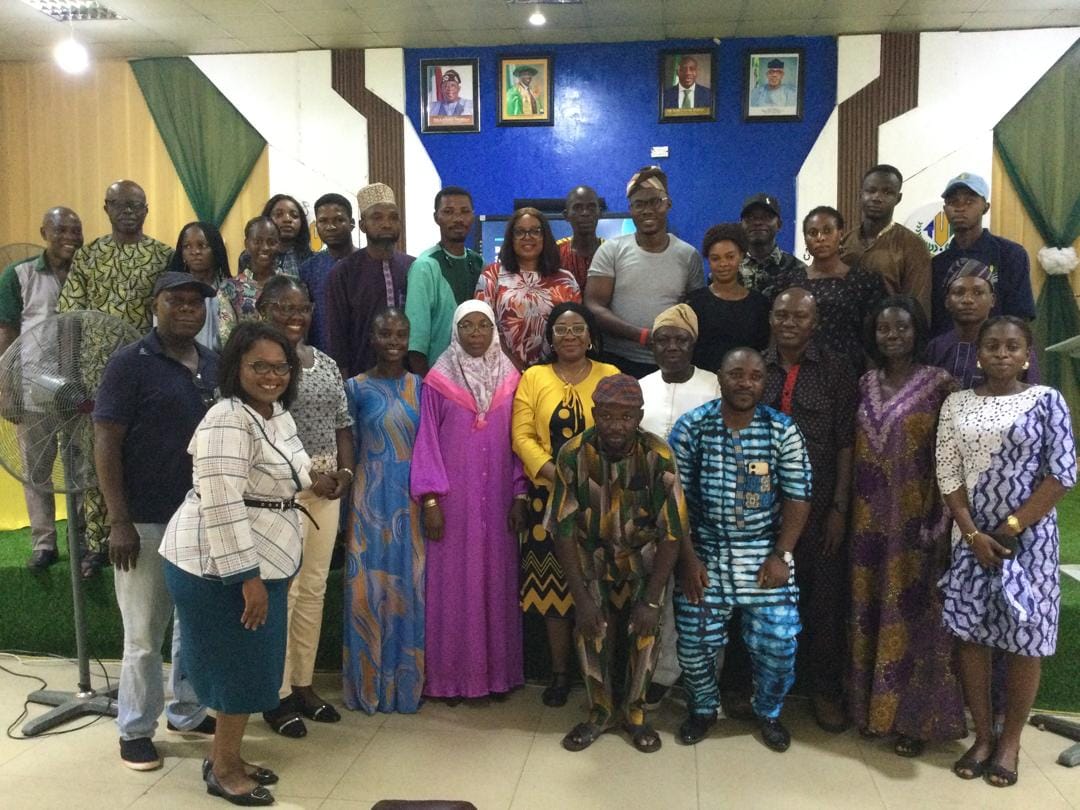
The Tai Solarin Federal University of Education (TASFUED), Ijagun, has intensified its drive to expand research visibility and attract competitive funding, as the Directorate of Research and External Relations (DRER) organised the second edition of its Concept Note Writing training programme for members of the University Community.
The training, tagged “Concept Note Writing 2.0,” was organised by the Directorate of Research and External Relations, DRER, in line with the STARWIN Agenda of the Vice-Chancellor, Prof. Samuel Oladipo MNPA, CMCPN, MCAN, FIELPN, and was designed to equip participants with the skills required to develop compelling research concept notes and proposals capable of attracting national and international grants.
Speaking at the programme, the Director, DRER, Prof.Olufunke Ekine, disclosed that strengthening the University’s research profile required not only the production of impactful research but also the ability of researchers to effectively communicate their ideas in ways that could attract funding.
She stressed that well-developed concept notes and research proposals were essential to positioning the University for greater visibility and access to funding opportunities, including the National Research Fund (NRF), Institutional-Based Grants (IBG) and other international funding schemes.
“For us as an institution to get visibility, we need our research out there in the open. For our research to be funded, we need to be able to write good concept notes and proposals that will attract the National Research Fund (NRF), Institutional-Based Grants (IBG), and several other international grants,” she added.
Prof. Ekine, who disclosed that she had benefited from research grants on several occasions, explained that the training was aimed at transferring practical knowledge and experience to academic staff and interested non-teaching staff to enable them identify funding opportunities and develop competitive applications.
Also speaking, the Director of the Directorate of Academic Planning, Quality Assurance and Accreditation (DAPQA), Prof. Jimoh Owoyele, described the training as a strategic intervention towards strengthening the University’s research culture and improving the capacity of its researchers to compete for available grants.
Prof. Owoyele, who was one of the resource persons, said the training was particularly timely given the ongoing call for applications for the National Research Fund, noting that the initiative was intended to encourage wider participation in research and grant applications across the University.
“We want as many participants as possible from TASFUED,” he said.
He urged members of the academic community to collaborate, share ideas and develop research proposals capable of competing successfully for available funding.
Speaking on the importance of research to institutional and societal development, Prof. Owoyele observed that the changing nature of human civilisation and the emergence of new challenges across different sectors made continuous research imperative.
He explained that research remained a critical instrument for expanding the frontiers of knowledge and developing solutions to societal challenges, stressing that TASFUED, as a University of Education, must remain at the forefront of research, innovation and knowledge development across relevant disciplines.
JThe training featured specialised sessions covering critical components of concept note development and grant applications.
Prof. Owoyele facilitated a session titled “The Dos and Don’ts of Concept Note Writing,” while Prof. Zubair Soluade took participants through “Methodology, Timeline and Grant Chart.”
Other sessions included “Budgeting,” facilitated by Prof. Ekine, and “Ready Sources for Funding,” delivered by Dr Oyesolape Akinsipo.
The programme attracted academic staff from the College of Science and Information Technology (COSIT), College of Specialised and Professional Education (COSMAS), and College of Humanities (COHUM).
The training further demonstrated DRER’s commitment to building a research-driven academic environment at TASFUED and equipping members of the University community with the capacity to transform research ideas into competitive, fundable projects with potential for institutional and societal impact.